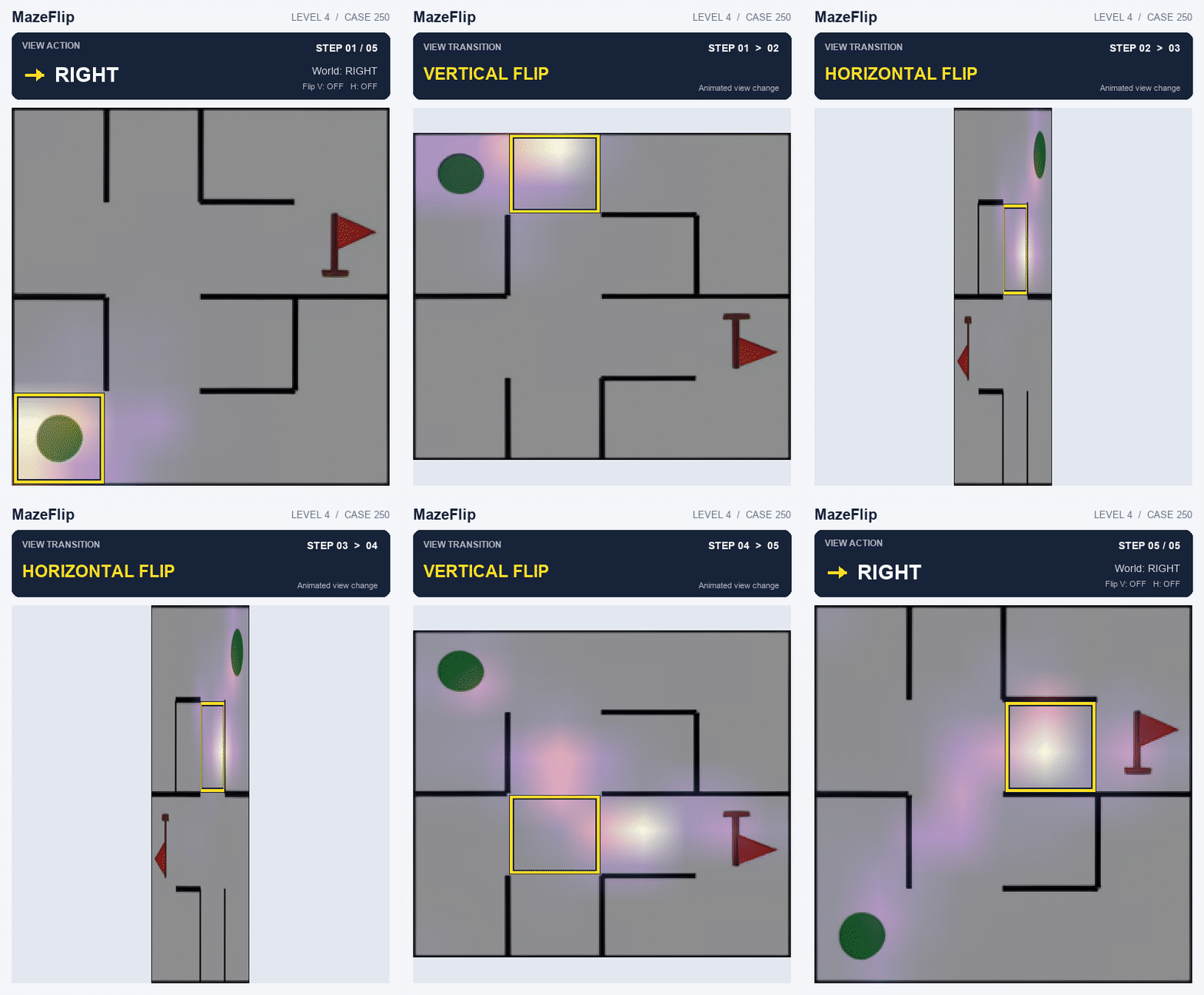
MazeFlip example 1
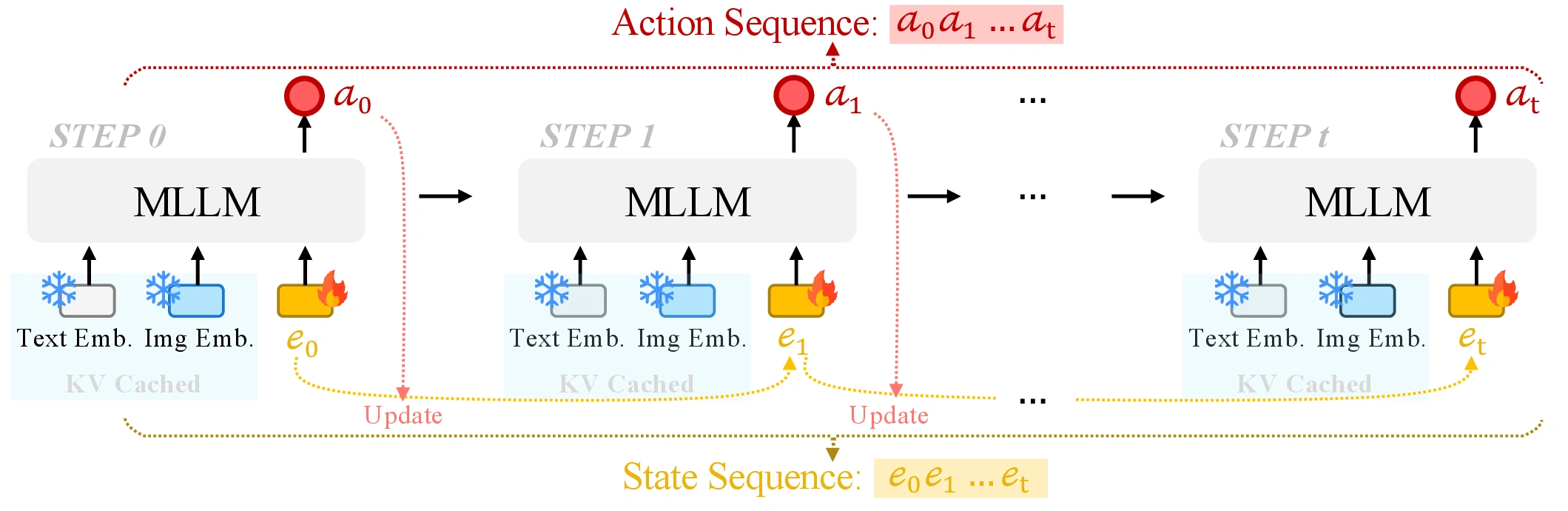
SSVR decouples static visual context from an action-conditioned recurrent latent state for open-loop planning.
To further investigate whether SSVR can be applied to dynamic‑map scenarios, we construct MazeFlip based on the Maze dataset. Specifically, we introduce dynamic properties to original Maze maps: LEFT/RIGHT actions trigger vertical flipping of the subsequent observation view, while UP/DOWN actions trigger horizontal flipping. The model only takes the initial map as input and is required to infer, via internal latent evolution (“mental simulation”), the correct optimal action sequence for reaching the destination under these dynamic rules.
After five epochs, SSVR reaches 86.20% EM and 94.82% PR, with a 99.90% legal-action rate.
| Epoch | Step | Legal ↑ | Closer ↑ | EM ↑ | PR ↑ | Entropy |
|---|---|---|---|---|---|---|
| 1 | 1,092 | 97.30% | 83.20% | 33.70% | 54.55% | 0.5601 |
| 2 | 2,184 | 99.60% | 98.10% | 60.50% | 80.02% | 0.4556 |
| 3 | 3,276 | 100.00% | 98.80% | 72.00% | 88.58% | 0.4712 |
| 4 | 4,368 | 100.00% | 99.80% | 80.40% | 92.25% | 0.4940 |
| 5 | 5,460 | 99.90% | 99.40% | 86.20% | 94.82% | 0.5002 |
Legal: valid-action rate. Closer: distance-reducing action rate. EM: exact match. PR: progress rate. Entropy is unitless. Download CSV.
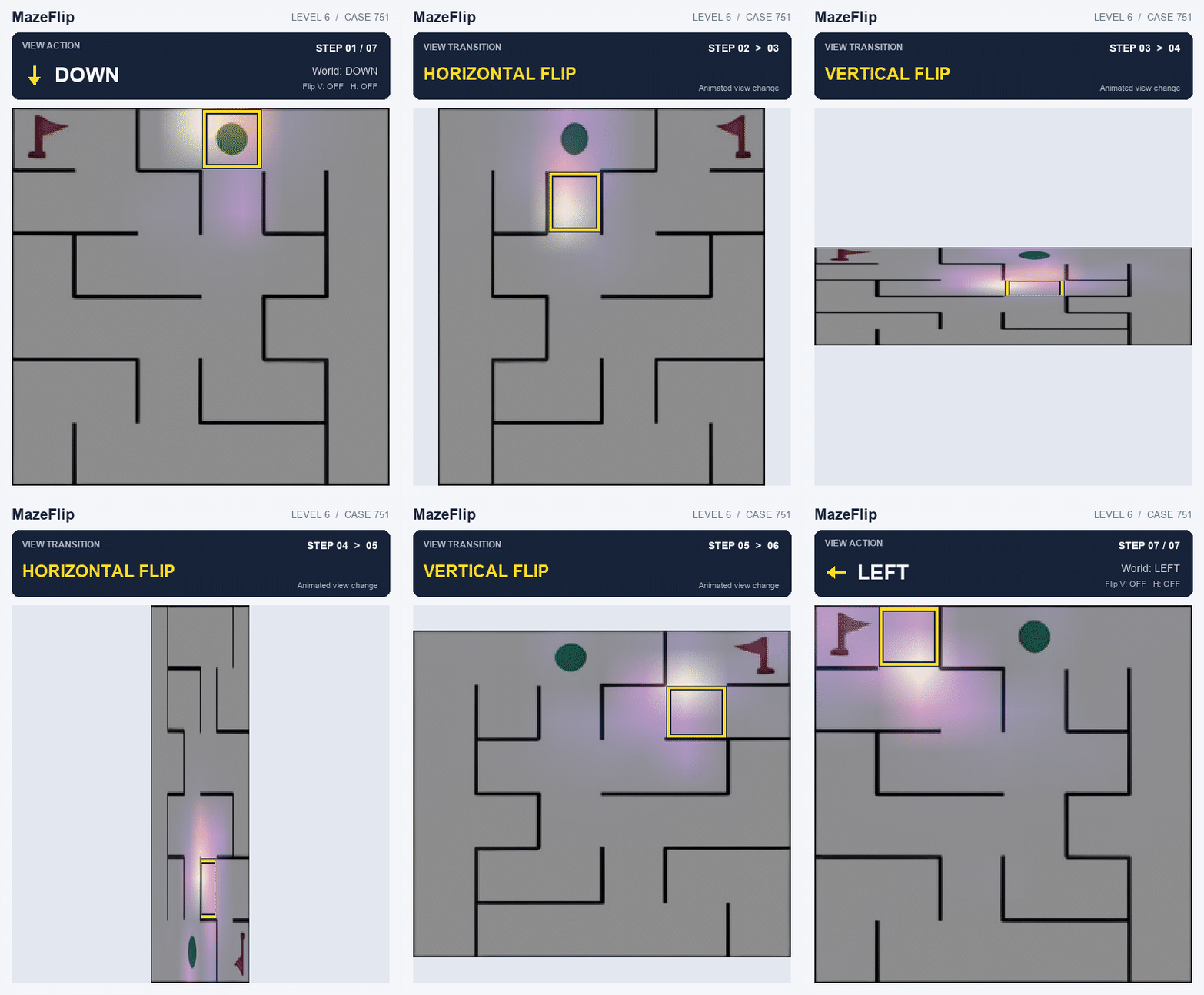
Yellow outlines mark the agent position before each action. The map and attention overlay are reflected together for visualization; flip animations do not represent additional observations supplied to the model. Use the selectors to view all eight MazeFlip cases.
Despite rapid progress in vision-language-action (VLA) models, existing reasoning paradigms still face a fundamental state-representation mismatch in open-loop planning. Given only an initial observation, models must internally simulate action-conditioned state transitions, whereas text-, pixel-, and latent-space reasoning can suffer from lossy spatial compression, error-accumulating visual generation, and bypass of intermediate latent tokens, respectively, undermining reliable long-horizon planning.
We propose State-Space Visual Reasoning (SSVR), which decouples static visual context, language constraints, and a recurrent latent state. SSVR encodes the initial image and instruction once, then conditions each action prediction on the latent state and updates it with an action-conditioned GRU. Using Qwen2.5-VL as the backbone, SSVR achieves 99.5/99.6, 96.3/98.0, and 83.9/90.6 EM/PR on FrozenLake, Maze, and MiniBehavior, substantially outperforming prior methods. Extensive experiments support the effectiveness of recurrent state modeling for VLA open-loop planning across input transformations and transfer settings.
By reusing static visual-textual context and updating a compact recurrent state, SSVR supports efficient multi-step inference, achieving up to 98.58× faster Maze decoding rollouts than the evaluated baselines with the prefix cache prebuilt.
SSVR encodes the initial image and instruction into reusable visual-textual context. At each step, a latent state token conditions action prediction through the pretrained language-model head. An action-conditioned GRU then updates this state for the next decision.
zt+1 = LN(GRU(Ea(at), zt))
The backbone uses Qwen2.5-VL with LoRA adaptation. Soft-target supervision balances safe and optimal actions; the main model uses α = 0.7.
SSVR achieves the highest EM and PR among the evaluated methods on all three tasks. Average EM/PR improves over VPRL by 12.6/11.2 percentage points.
Risk-aware navigation
Topological path finding
Phased object interaction
| Method | Paradigm | FrozenLake | Maze | MiniBehavior | Average |
|---|---|---|---|---|---|
| Gemini 2.0 Flash Direct* | Text | 21.2 / 47.6 | 8.3 / 31.4 | 0.7 / 29.8 | 10.1 / 36.3 |
| Gemini 2.0 Flash CoT* | Text | 27.6 / 52.5 | 6.9 / 29.8 | 4.0 / 31.2 | 12.8 / 37.8 |
| Gemini 2.5 Pro* | Text | 72.0 / 85.0 | 21.5 / 35.5 | 37.6 / 59.9 | 43.7 / 60.1 |
| Qwen2.5-VL-7B Direct* | Text | 1.2 / 15.0 | 0.6 / 14.5 | 0.3 / 9.8 | 0.7 / 13.1 |
| Qwen2.5-VL-7B CoT* | Text | 8.2 / 29.1 | 2.3 / 15.2 | 0.5 / 14.7 | 3.7 / 19.7 |
| Qwen2.5-VL-7B SFT | Text | 68.6 / 84.4 | 60.9 / 70.3 | 31.3 / 56.1 | 53.6 / 69.9 |
| VPFT | Pixel | 75.4 / 79.5 | 59.0 / 64.0 | 33.8 / 52.2 | 56.1 / 65.2 |
| VPRL | Pixel | 91.6 / 93.2 | 74.5 / 77.6 | 75.8 / 83.8 | 80.6 / 84.9 |
| LVR* | Latent | 6.8 / 16.0 | 5.0 / 10.2 | 0.0 / 8.0 | 3.9 / 11.3 |
| Monet* | Latent | 5.0 / 13.0 | 2.3 / 5.0 | 0.0 / 7.5 | 2.4 / 8.5 |
| SSVR (ours) | Recurrent state | 99.5 / 99.6 | 96.3 / 98.0 | 83.9 / 90.6 | 93.2 / 96.1 |
With a prebuilt prefix cache, SSVR decodes a Maze rollout in 182.442 ms, yielding a 98.58× speedup over VPRL under the reported timing protocol.
| Method | Rollout latency (ms) | Relative latency |
|---|---|---|
| SSVR + cache | 182.442 | 1.00× |
| SSVR | 356.634 | 1.95× |
| LVR | 1,059.193 | 5.81× |
| Monet | 6,975.866 | 38.24× |
| VPRL | 17,984.442 | 98.58× |
All methods use the same Maze case. Latency excludes preprocessing and prefix-cache construction; this is not an end-to-end timing comparison.
Performance remains close to baseline under image enlargement. Downscaling affects harder maps more strongly, consistent with sensitivity to loss of fine spatial detail.
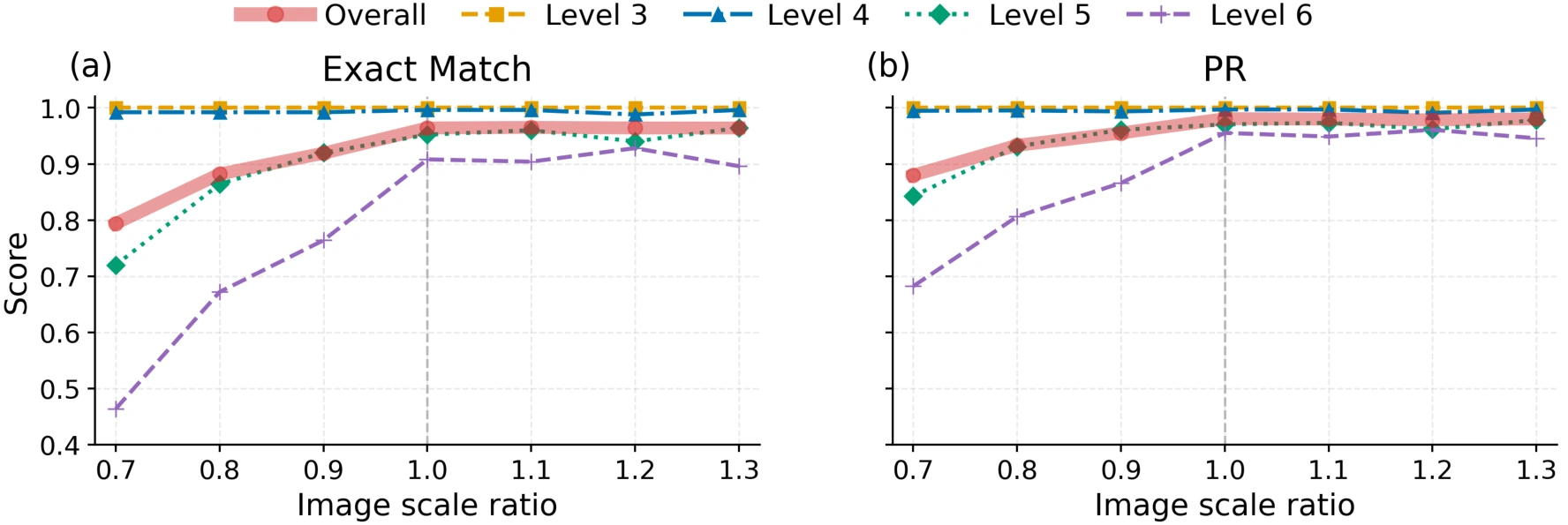
The scale experiments report a 96.4% Maze EM baseline; the main comparison reports 96.3%. Each result is retained under its original experimental setting.
Action-specific visual attribution evolves with the recurrent state. Select a trajectory to inspect navigation and object-interaction decisions.
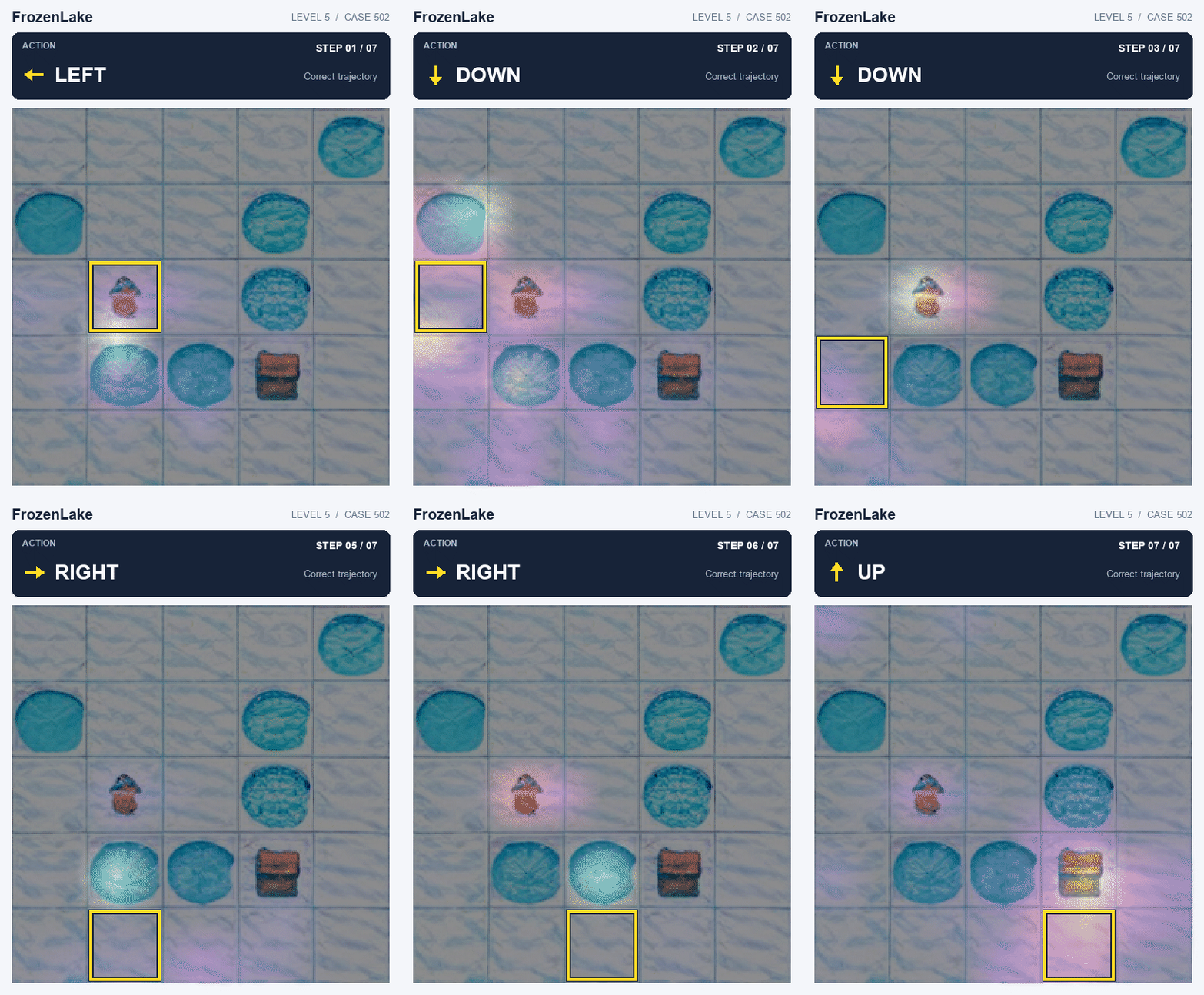
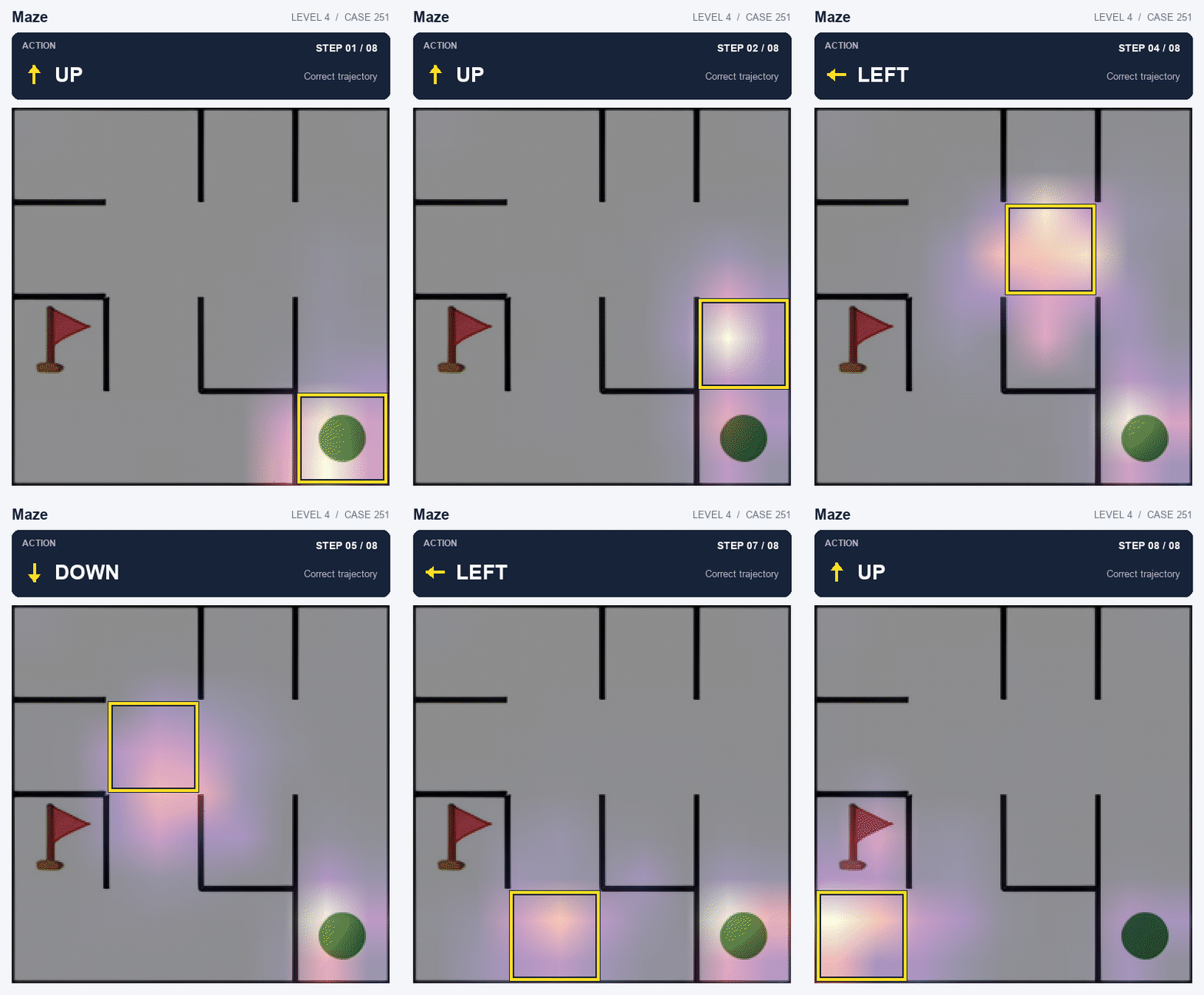
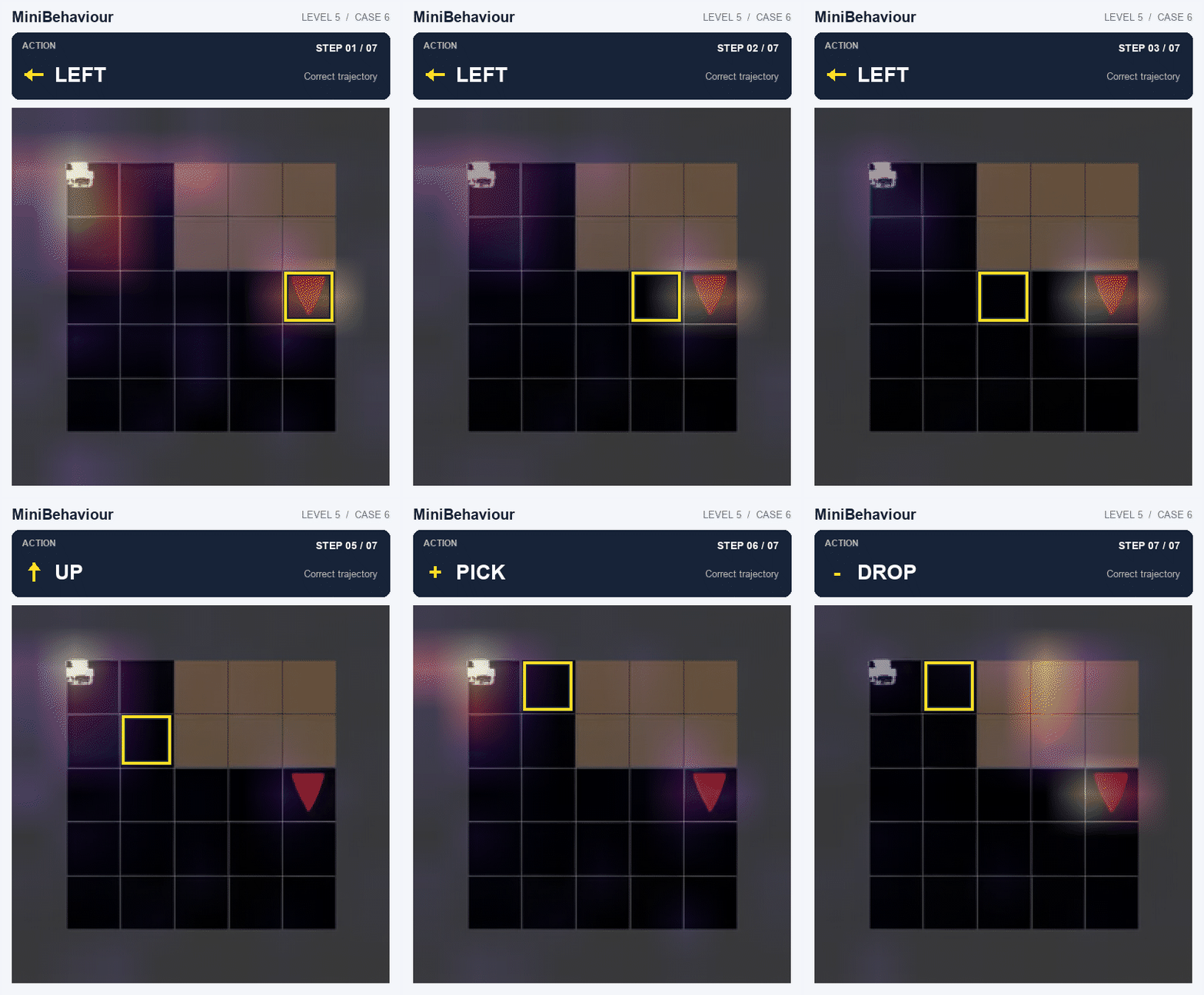
Yellow outlines indicate the current position before the action; original sprites mark initial locations. All 31 successful cases contain at least three actions (including PICK/DROP); the eight MazeFlip cases appear above.